
In our previous Insights article, Future Trends in Business Communication Technology, we explored how modern communication tools are reshaping how businesses collaborate, serve customers, and operate at scale. Those trends point to faster systems, cloud-based platforms, and always-on connectivity. But for many small and medium-sized businesses, the excitement around new technology is often followed by a difficult question. How do you pay for it without letting IT costs spiral out of control?
Cost optimization has become one of the most pressing challenges for SMBs across the U.S. Business owners want reliable systems, secure data, and tools that support growth. At the same time, many organizations do not have in-house IT teams to manage spending, vendor contracts, or infrastructure decisions. This gap often leads to overpaying for services, underusing software, or delaying critical upgrades that eventually cost more.
The opportunity lies in approaching IT costs strategically rather than reactively. Cutting costs does not mean cutting corners or accepting lower quality. When done correctly, cost optimization improves performance, reduces risk, and aligns technology spending with real business goals. For healthcare practices, real estate brokerages, and service-based companies, this approach creates stability instead of uncertainty.
Why IT Cost Optimization Is a Business Strategy, Not a Budget Cut
Many SMBs treat IT costs as fixed expenses rather than adjustable investments. Monthly software subscriptions, hardware replacements, and support fees accumulate quietly in the background. Over time, these costs grow disconnected from actual usage or value delivered. Without visibility, decision-makers often assume high costs are unavoidable.
True cost optimization begins with understanding where money is going and why. Research shows that organizations waste an average of 30 percent of their cloud spend due to idle resources and poor visibility (Statista, 2025). This waste is rarely intentional. It happens because systems were added quickly to solve short-term problems without long-term planning.
When businesses view IT spending as a strategic lever, priorities change. Leaders begin asking whether tools support revenue, reduce risk, or improve efficiency. Costs that do not meet those criteria become candidates for consolidation or replacement. This shift helps SMBs regain control without disrupting daily operations.
For companies working with partners like Gooey IT, cost optimization becomes an ongoing process rather than a one-time exercise. Regular reviews, usage audits, and performance checks ensure technology continues to earn its place in the budget.
The Hidden Costs That Quietly Drain IT Budgets
Some of the most expensive IT problems are not obvious line items on a balance sheet. Legacy systems, outdated hardware, and overlapping software licenses often go unnoticed for years. These hidden costs increase support time, slow down employees, and create security risks that are expensive to fix later.
Security incidents are a major example of hidden cost exposure. According to the Verizon Data Breach Investigations Report, small businesses are increasingly targeted because they often lack dedicated security resources. The financial impact of downtime, recovery, and reputational damage far exceeds the cost of preventative measures.
Another common issue is underutilized software. SMBs frequently pay for features they never use because licenses were purchased at a higher tier than needed. Over time, these small overpayments add up. Without regular reviews, businesses continue paying out of habit rather than necessity.
Cost optimization focuses on identifying and correcting these inefficiencies. By aligning technology with real-world usage, businesses reduce waste while improving reliability. This approach protects both the budget and the business itself.
Cloud and Managed Services as Cost-Control Tools
Cloud technology is often misunderstood as inherently expensive. In reality, cloud platforms offer flexibility that traditional infrastructure cannot match. The challenge is not the cloud itself but how it is managed. Poor configuration and lack of oversight quickly lead to inflated bills.
Data from IBM shows that businesses that actively manage cloud resources experience lower operational costs and better scalability. Rightsizing servers, automating shutdowns, and monitoring usage patterns make a significant difference. These practices allow SMBs to pay only for what they actually need.
Managed IT services play a critical role in this process. Instead of hiring full-time staff, SMBs gain access to a team that monitors systems, handles updates, and optimizes spending. This model converts unpredictable IT expenses into stable, predictable monthly costs.
For growing businesses, managed services also reduce risk. Proactive monitoring prevents small issues from becoming expensive emergencies. Over time, this consistency supports growth without sudden financial shocks tied to technology failures.
Balancing Security, Performance, and Cost
One of the biggest fears around cost optimization is that security or performance will suffer. In reality, inefficient systems are often less secure and less reliable. Outdated software, unpatched systems, and unsupported hardware increase both costs and risk.
The National Institute of Standards and Technology emphasizes that strong cybersecurity frameworks reduce long-term costs by preventing incidents rather than reacting to them. Preventative security investments are almost always cheaper than recovery efforts. This is especially important for healthcare and real estate organizations that handle sensitive data.
Performance also improves when systems are properly aligned. Employees waste less time dealing with slow tools, repeated logins, or system crashes. Productivity gains translate directly into financial value. When people can work efficiently, businesses serve clients better and close deals faster.
Cost optimization, when executed correctly, strengthens all three areas. Security becomes proactive, performance becomes consistent, and costs become predictable. This balance is what allows SMBs to scale with confidence rather than caution.
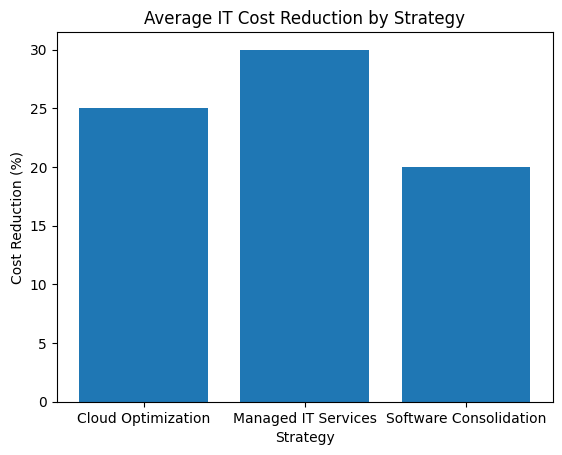
Source: Statista, 2025
Building a Sustainable IT Cost Strategy for Growth
Cost optimization is not about spending less at all costs. It is about spending smarter over time. Businesses that succeed in this area revisit their technology strategy regularly and adjust as goals evolve. What worked two years ago may no longer fit current operations.
Linking cost strategy to future planning is essential. As discussed in Future Trends in Business Communication Technology, digital tools will continue to evolve rapidly. Businesses that optimize today are better positioned to adopt new solutions tomorrow without financial strain. This forward-looking mindset separates reactive organizations from resilient ones.
Partnerships also matter. Working with a trusted IT provider ensures decisions are based on expertise rather than guesswork. SMBs gain access to best practices, benchmarks, and ongoing guidance that would be difficult to maintain internally. This relationship transforms IT from a cost center into a growth enabler.
In the long run, cutting IT costs without cutting quality is not only possible. It is necessary. Businesses that master this balance protect their resources, their data, and their future.
REFERENCES
IBM. (2024). What is cloud computing? https://www.ibm.com/topics/cloud-computing
National Institute of Standards and Technology. (2024). Cybersecurity Framework. https://www.nist.gov/cyberframework
Statista. (2025). Cloud computing cost optimization statistics. https://www.statista.com
Verizon. (2024). Data Breach Investigations Report. https://www.verizon.com/business/resources/reports/dbir/
Gooey IT. (2024). Future Trends in Business Communication Technology. https://gooeyit.com/blog/future-trends-business-communication-technology
.png)